DIGITAL TRANSFORMATION GLOSSARY
This is a glossary of common terms associated with the ever evolving internet age that we live in. The aim is to help non-techies familiarize themselves with these terms in a easy to understand, summarised and illustrated format, with an hierachical listing whereby each term builds upon the knowledge gained from the previous term.
- The terms "internet," "web," and "digital" are related but distinct.
- Internet is the global network of interconnected computers, providing the infrastructure for communication.
- World Wide Web (web) is a system of interconnected documents (websites) and other resources accessed via the internet.
- Digital refers to any information represented in a binary format (0s and 1s), encompassing both the internet and web, as well as other technologies like digital storage and digital marketing.
Electronic Commerce is the buying and selling of goods and services over the internet. It involves transactions that can happen between businesses and consumers (B2C), or between businesses (B2B), and encompasses a wide range of activities, including online shopping, booking travel, and purchasing digital products.
Digital Payments are electronic transactions that use digital devices and the internet to transfer money, eliminating the need for physical cash. They include a wide range of methods like mobile wallets (e.g., Apple Pay, Google Pay), online bank transfers, credit/debit cards, and cryptocurrencies.
Mobile Money is an electronic wallet service. This is available in many countries and allows users to store, send, and receive money using their mobile phone. The safe and easy electronic payments make Mobile money a popular alternative to bank accounts.
Digitization is the process of converting information into a digital (i.e.,
computer-readable) format.
Digitalization is the broader use of digital technologies to transform processes, operations, and business models
Digitalization is the broader use of digital technologies to transform processes, operations, and business models
A GAP analysis compares a current state to a desired future state to identify differences, called "gaps," and develop action plans to close those gaps. This analysis helps organizations understand what needs to be changed or improved to achieve their goals - source
A SWOT analysis is a strategic planning tool that helps businesses and individuals identify their internal strengths and weaknesses, as well as external opportunities and threats. It's a framework for assessing a company's position in the market and making more informed decisions. - source
- Website is a collection of web pages accessible via a URL.
- Web app is an application that runs in a web browser but offers more interactive functionality than a typical website.
- Mobile app is a native application designed for specific mobile operating systems (like iOS or Android) and installed on a device.
Minimal Viable Product is the most basic version of a product with just enough features to be usable by early adopters, allowing for feedback and validation of the product idea. It's a strategy focused on learning from user interaction and iteratively improving the product based on that feedback, rather than building a fully-featured product from the start.
A startup is a new, young company founded by entrepreneurs to develop a scalable business model, often based on an innovative idea with the potential for rapid growth. Unlike traditional businesses, startups are in a phase of searching for a repeatable business model and are characterized by innovation, potential for rapid expansion, external funding, and high uncertainty. They aim to grow large, beyond a single founder, and can range from tech-focused companies to other sectors with a scalable impact.
A startup incubator is an organization that helps new and early-stage companies grow by providing a supportive environment with resources such as mentorship, office space, networking opportunities, and access to capital. These programs are designed to help entrepreneurs develop their business ideas, build a strong foundation, and navigate the challenges of starting a business in its initial phase.
A digital hub is a physical or virtual space that acts as a central point for digital activities, resources, and communities. It can be a physical workspace for entrepreneurs and companies, a platform for data management, or a community center for developing digital skills. These hubs foster collaboration, provide technical infrastructure, and offer support to help individuals and businesses thrive in the digital landscape.
This refers to a virtual network of computing services usually offered through digital platforms like AWS, Google-cloud & Azure and many others with varying degrees of service offerings. Instead of owning and managing physical data centers and servers, users can access these resources from a cloud provider, paying only for what they use. This model provides benefits like scalability, cost efficiency, and flexibility for businesses and individuals alike. source
Wireless Fidelity is a technology that enables devices to connect to the Internet wirelessly. More devices and users can communicate simultaneously. The range is typically 30 to 50 meters indoor and 90 meters outdoor.
Bluetooth is a wireless technology that is used to connect devices in a short range of about 10 meters.
Internet of things (IoT) describes devices with sensors, processing ability, software and other technologies that connect and exchange data with other devices and systems over the Internet or other communication networks source
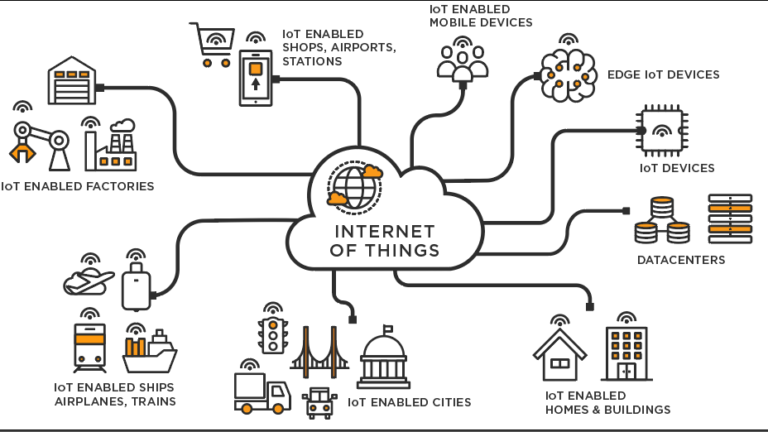
Smart devices are electronic gadgets that can connect to the internet or other networks, enabling them to exchange data and automate tasks. These include common items like smartphones, smart TVs, and smart appliances, as well as specialized gadgets like smart speakers, thermostats, and security cameras, which can be controlled remotely and can interact with each other. source
Home automation or domotics is building automation for a home. A home automation system will monitor and/or control home attributes such as lighting, climate, entertainment systems, and appliances. It may also include home security such as access control and alarm systems. Smart home refers to home automation devices that have internet access. source